By Ricardo Amaro
February 6, 2025
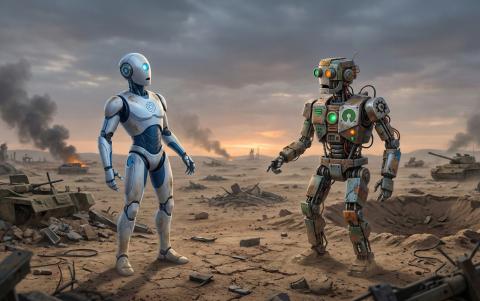
Remember the "AI Wars" of 2023? The endless Twitter debates about whether open-source models would "kill" OpenAI, or if proprietary giants would leave everyone else in the digital dust?
I have news for you: The war is over. And looking around the landscape in February 2026, it’s clear that nobody won—because we were fighting over the wrong thing.
The industry hasn't collapsed into a monopoly, nor has it democratized into a utopia. Instead, it has bifurcated. We have entered an era of rigorous industrial consolidation where "Intelligence" has split into two distinct products: Utilities and Thinkers.
If you are still trying to decide between "Open vs. Closed" for your entire tech stack, you are asking a 2024 question in a 2026 world. Here is the reality of the new landscape.
The "Intelligence Gap" is Now a Ditch
For years, the fear was that open models would perpetually lag years behind GPT-4 or Gemini. Today, that gap has compressed to approximately three months.
But here is the twist: the models aren't competing for the same jobs anymore.
Proprietary (The "Thinkers"): OpenAI’s GPT-5.2 and Google’s Gemini 3 have pivoted entirely to "System 2" reasoning. You don't pay them to chat; you pay them to think. With features like "High Effort" reasoning tokens, these models pause, deliberate, and critique their own logic before answering. They are expensive, slow, and indispensable for "Zero-to-One" tasks like complex legal discovery or novel software architecture.
Open Weights (The "Utilities"): Meanwhile, Meta’s Llama 4 and Mistral’s Large 3 have conquered the "One-to-N" market. They are the workhorses. Need to summarize 10 million tokens of corporate archives? Llama 4 Scout does that locally, securely, and for a fraction of the cost.
The Takeaway: You don't hire a PhD physicist to screw in a lightbulb, and you don't ask a handyman to solve quantum mechanics. Stop comparing them. Use proprietary for reasoning and open source for scale.
The Death of the "Vanilla" Transformer
The most under-reported story of 2026 is that the Transformer architecture—the "T" in GPT—is no longer the only game in town. The quadratic math of Attention (O(n²) was simply too expensive for the massive context windows we demanded.
Two technologies have quietly revolutionized the substrate of AI:
The 1-Bit Revolution: Microsoft Research proved it was possible with BitNet b1.58 back in 2024, but now it’s the standard. By training models with ternary weights (-1,0,1), we’ve eliminated expensive floating-point multiplication. We are now running massive models on CPUs with energy efficiency we couldn't dream of two years ago.
The Return of Recurrence: Architectures like BlackMamba (a hybrid of Mamba State Space Models and Mixture-of-Experts) have solved the memory bottleneck. They offer linear scaling, allowing us to process infinite streams of data without the hardware choking.
The Energy Wall is the Only Metric That Matters
Forget parameter counts. The only metric that matters in 2026 is Joules per Token.
The data center industry hit a hard "Energy Wall" late last year. Grid capacity in major hubs like Northern Virginia is tapped out. This has forced the "Nuclear Pivot" we are seeing today.
Microsoft’s bet on Helion Energy (fusion) and the broader industry move toward Small Modular Reactors (SMRs) aren't PR stunts; they are survival strategies. The "Intelligence" of the future is being built behind the meter, disconnected from the public grid. If you aren't factoring energy efficiency into your AI deployment strategy, you aren't ready for scale.
From Chatbots to "Computer Use"
The "Chatbot Era" is effectively dead. The novelty of talking to a text box has worn off. The value has shifted to Agents.
We are seeing this with Google’s Project Mariner and Anthropic’s Claude. These aren't systems you talk to; they are systems you assign work to. They have "Computer Use" capabilities—they can see your screen, move your cursor, and navigate legacy software interfaces just like a human employee.
The metric of success isn't "did it write a good poem?" It's "did it successfully navigate the CRM, update the database, and email the client without hallucinating?"
The Regulatory Splinternet
Finally, the legal landscape has fractured the world into two distinct realities.
The US: Under the 2025 Executive Order, the focus is on deregulation and "minimally burdensome" standards to maintain an edge over China.
The EU: As of August 2026, the EU AI Act is fully enforceable. High-risk systems face mandatory conformity assessments and transparency logs.
This has created a "Splinternet" of AI. Companies are now deploying different models for different regions—unconstrained "reasoning" models in the US, and highly-regulated, explainable "utility" models in Europe.
Conclusion: Pick Your Tool, Not Your Tribe
The war is over. The tribalism of "OpenAI vs. The World" is a relic of the early 2020s.
In 2026, the winning strategy is hybrid. You need a local, 1-bit, open-source model for your high-volume private data, and a secure pipeline to a proprietary "reasoning" model for your hardest problems.
The question isn't "which model is best?" The question is "what is the cost of not knowing the difference?"