
By Ricardo Amaro
February 20, 2026
Why $20 IoT Devices Are About to Get Dangerously Smart
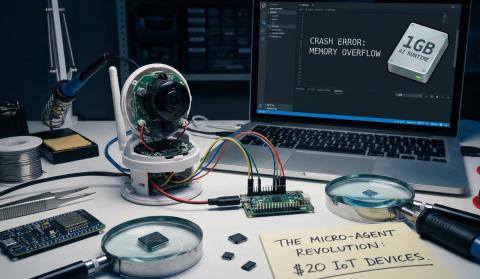
Ever tried cramming a 1-gigabyte AI runtime onto a $20 security camera? It is a spectacular way to instantly crash your hardware and kill your deployment timeline. For years, hardware engineers and data scientists have been trapped in a deeply frustrating compromise: either build "dumb" edge devices that rely on slow, expensive cloud APIs, or force heavily bloated software onto critically constrained hardware.
The enterprise AI market is expanding at a staggering 30% compound annual growth rate, rapidly transitioning from experimental laboratories to mission-critical infrastructure.1 Yet, as autonomous capabilities push closer to the physical world—into manufacturing lines, smart home hubs, and surveillance networks—the physical limitations of embedded hardware have exposed a massive architectural flaw in current agent frameworks.
The solution is not bigger hardware. The solution is radically smaller software.
We are officially entering the era of the embedded micro-agent. Driven by ultra-lightweight, statically compiled languages—and a renewed focus on strict, minimal architectures—a new breed of AI agents is completely eradicating the overhead of traditional runtimes. They enable advanced, secure, and instantaneous decision-making on microcontrollers that cost less than a cup of coffee.
Here is exactly how these tiny autonomous agents are about to rewrite the rules of IoT and surveillance.
The Bloat Crisis: Why Traditional Frameworks Fail at the Edge
The initial wave of open-source autonomous agents proved the viability of self-directed artificial intelligence, but it relied heavily on high-level, interpreted languages like TypeScript and Python.2 Frameworks such as OpenClaw require a Node.js runtime. This setup routinely consumes upwards of 1GB of RAM and takes over 500 seconds to cold-start on constrained processors.3 On an edge computing device or a smart surveillance camera with only 64MB or 256MB of memory, this overhead is not just inefficient—it is paralyzing.
Deploying bulky runtimes onto embedded IoT devices introduces cascading hardware failures. Flash storage degrades rapidly under heavy dependency management, while massive memory footprints force the operating system to aggressively terminate critical processes to keep the device breathing.
Furthermore, deploying extensive Node or Python ecosystems onto edge devices drastically expands your attack surface. Security audits of early high-level agents revealed catastrophic vulnerabilities, including prompt injection, Server-Side Request Forgery (SSRF), and the silent exfiltration of message histories.4 When an autonomous agent has root access to a corporate surveillance network, a memory leak or an unhandled dependency exception is an unacceptable physical security risk.
NanoClaw: Security Through Container Isolation
While compiled languages offer the ultimate hardware efficiency, some developers are rethinking TypeScript by focusing strictly on minimal code and maximum OS-level security.
NanoClaw strips the AI assistant concept down to roughly 500 lines of core code, proving that you do not need massive abstractions to build a functional agent. Instead of running a monolithic Node process with shared memory and application-level permission checks like OpenClaw, NanoClaw runs each chat context inside actual OS-level Linux or Apple containers.
This ensures strict filesystem isolation. The agent can only see what is explicitly mounted to its specific container, allowing safe Bash execution without risking the host machine. By prioritizing security through hardware-level isolation rather than complex software rules, NanoClaw mitigates severe vulnerabilities while maintaining a codebase small enough to be understood in minutes.
The Compiled Antidote: Go and Rust
While NanoClaw solves security, the physical constraints of IoT hardware demand a fundamental architectural reset. The industry is witnessing a massive pivot toward compiled languages, specifically Go and Rust. These languages yield static binaries that execute directly on the host operating system without requiring intermediary virtual machines or garbage-collected runtimes.5
This shift represents a transition from brute-force compute to elegant, deterministic software engineering. The performance differential between traditional frameworks and compiled edge agents is immense, fundamentally altering the economics of hardware deployment.
Data metrics standardized for low-power edge hardware execution.
PicoClaw: The Go-Native Workhorse
PicoClaw represents the absolute democratization of edge intelligence. Written entirely in Go, it is an ultra-efficient, single-binary AI assistant designed specifically for environments where every megabyte counts.7
Fascinatingly, PicoClaw was developed through an AI-bootstrapped process where an artificial intelligence drove its own architectural migration, resulting in a core that is 95% agent-generated and subsequently refined by humans.7 Compiling down to a self-contained binary, PicoClaw operates flawlessly across RISC-V, ARM, and x86 architectures, consuming less than 10MB of memory in optimal states.7
For technical teams, PicoClaw brings heavy-hitting features to edge devices:
- Protocol-First Routing: The project relies on a model_list architecture, allowing zero-code addition of new LLM providers via protocol prefixes (e.g., openai/, anthropic/, deepseek/).7
- Automatic Load Balancing: Multiple endpoints can be configured for a single model alias. If a primary local endpoint drops off the network, the agent instantly round-robins the request to a secondary node, ensuring high availability.7
- Native Channel Integrations: PicoClaw natively hooks into Telegram, Discord, WeCom, and DingTalk via built-in gateways.7 An engineer can literally ping a $20 camera via a Discord webhook and ask it to report its local status or run an automated diagnostic.
- Strict Sandboxing: The default restrict_to_workspace setting ensures that the agent's file read/write operations and command executions are locked strictly to its designated workspace, mitigating major security risks.7
ZeroClaw: Uncompromising Determinism in Rust
For environments where hardware limits are extreme and absolute determinism is non-negotiable, ZeroClaw strips the agent runtime down to its barest molecular structure. Utilizing Rust's aggressive compiler and strict ownership model, ZeroClaw completely eliminates data races and null pointer dereferences—classes of errors that routinely cripple multithreaded Python applications.6
ZeroClaw compiles to a remarkably small 3.4MB binary and boasts a cold startup time of under 10 milliseconds.10 This blinding speed allows the agent to function less like a continuous background service and more like a high-performance system daemon that wakes, acts, and suspends instantaneously to save power.
Crucially, ZeroClaw redefines edge security using a deeply modular architecture:
- Trait-Based Architecture: Instead of hardcoding functionality, ZeroClaw exposes its entire extension surface via Rust traits (e.g., Provider, Channel, Tool, Memory).11
- WASM Sandboxing: To execute potentially dangerous operations without risking the host system, modern Rust implementations leverage WebAssembly (WASM) sandboxing.2 By isolating tool execution within a WASM container, the agent can parse sensitive device sensors or trigger network actions without ever gaining unauthorized access to the host's filesystem or credential stores.
- Zero Overhead: Running on less than 5MB of RAM, ZeroClaw requires 99% less memory than OpenClaw and is fully agnostic to its environment.10
Hardware Synergy: Unlocking the $20 AI Device
Software efficiency is only half of the equation; the emergence of powerful, ultra-cheap silicon forms the bedrock of this revolution. Devices like the Sipeed LicheeRV Nano and the MaixCAM are completely redefining baseline expectations for IoT hardware.
Powered by the SOPHGO SG2002 processor, the LicheeRV Nano is a super-mini development board measuring just 22.86mm by 35.56mm. Despite its size, it packs an astonishing punch: a 1GHz RISC-V core, an optional ARM Cortex-A53 core, 256MB of DDR3 RAM, dual-band WIFI6, and—most importantly—an integrated 1 TOPS Neural Processing Unit (NPU).7
The presence of a dedicated NPU on a $20 board is a total game-changer for autonomous agents. NPUs execute the heavy matrix multiplications required for AI workloads locally, with minimal heat generation and power consumption.14
When an agent like PicoClaw or ZeroClaw runs on the LicheeRV Nano, the CPU orchestrates the logic, memory management, and network routing. Meanwhile, the NPU handles continuous sensory processing—such as real-time visual recognition using INT8 quantized YOLO models.14 This offloads the heavy lifting, allowing the tiny agent binary to make instant, autonomous decisions based on the NPU's localized inferences.
We are also seeing the rapid maturation of Small Language Models (SLMs) tailored for these exact devices. Models like DeepSeek R1 (1.5B), LFM2-350M, and Qwen are being heavily quantized to run efficiently on CPU/NPU combinations with limited RAM.15 An embedded agent no longer needs to blindly ping OpenAI to understand a text trigger; it can process basic reasoning natively.
Transforming Surveillance and Industrial IoT
The convergence of embedded hardware and lightweight compiled agents solves the critical latency, bandwidth, and privacy issues inherent to cloud-based monitoring.
Traditional security systems constantly stream heavy raw video data to external servers for processing. This creates massive bandwidth bottlenecks and introduces severe privacy liabilities—especially if the data traverses public networks.17
By embedding ZeroClaw or PicoClaw directly onto a camera's system-on-chip, intelligence happens at the absolute edge. A surveillance system utilizing the General Purpose Input/Output (GPIO) pins on a custom board can physically control tilt motors, trigger alarm relays, and log network events autonomously.18
Imagine a secure facility: If an unauthorized person enters a restricted zone, the camera’s NPU processes the visual data stream locally. The embedded PicoClaw agent evaluates the anomaly, generates an alert narrative, and transmits a localized warning via a secure internal webhook in milliseconds—entirely bypassing the public internet.7
This localized approach also guarantees operational resilience. In industrial manufacturing environments or remote agricultural monitoring, internet connectivity is frequently unstable. An autonomous agent running natively on the device retains full operational capacity offline. It continues to execute predictive maintenance protocols, monitor thermal sensors, and store critical insights locally until network access is safely restored.21
The Future is Invisible Intelligence
The shift toward highly optimized, statically compiled agents like ZeroClaw and PicoClaw signals the true maturation of the artificial intelligence sector. By abandoning the immense bloat of web-era scripting languages, developers are finally unlocking the true potential of the Internet of Things.
Intelligence is no longer a centralized, expensive resource accessed via high-latency API calls. It is becoming a ubiquitous, invisible layer embedded directly into the fabric of everyday devices.
As the industry moves aggressively toward secure-by-default, low-latency micro-agents, the boundaries of what a $20 piece of hardware can accomplish will continue to expand. The days of melting microcontrollers with gigabyte runtimes are over. The future belongs to the lean, the compiled, and the blazingly fast.
Are you building next-generation edge applications or optimizing AI for constrained environments? Let's connect and push the boundaries of what hardware can do.
👉 Follow me on Linkedin https://www.linkedin.com/in/ricardoamaro/
Works cited
- Top 10 trends in AI adoption for enterprises in 2025 - Glean, accessed on February 20, 2026, https://www.glean.com/perspectives/enterprise-insights-from-ai
- OpenClaw, NanoBot, PicoClaw, IronClaw and ZeroClaw: This *Claw Craziness Is Continuing… | by evoailabs | Feb, 2026, accessed on February 20, 2026, https://evoailabs.medium.com/openclaw-nanobot-picoclaw-ironclaw-and-zeroclaw-this-claw-craziness-is-continuing-87c72456e6dc
- zeroclaw/README.md at main · zeroclaw-labs/zeroclaw · GitHub, accessed on February 20, 2026, https://github.com/zeroclaw-labs/zeroclaw/blob/main/README.md
- 5 Open Source & Enterprise-Ready OpenClaw Alternatives for AI Automation - Adopt AI, accessed on February 20, 2026, https://www.adopt.ai/blog/open-source-enterprise-openclaw-alternatives
- Rust vs Go: Which One to Choose in 2025 - The JetBrains Blog, accessed on February 20, 2026, https://blog.jetbrains.com/rust/2025/06/12/rust-vs-go/
- Rust Microservices: Is Choosing Rust Over Go a Bad Idea? - SCAND, accessed on February 20, 2026, https://scand.com/company/blog/rust-vs-go/
- sipeed/picoclaw: Tiny, Fast, and Deployable anywhere ... - GitHub, accessed on February 20, 2026, https://github.com/sipeed/picoclaw/
- PicoClaw - AI Agent Store, accessed on February 20, 2026, https://aiagentstore.ai/ai-agent/picoclaw
- Is Go as memory safe as Rust? : r/golang - Reddit, accessed on February 20, 2026, https://www.reddit.com/r/golang/comments/1oiqyu3/is_go_as_memory_safe_as_rust/
- zeroclaw-labs/zeroclaw: Fast, small, and fully autonomous AI assistant infrastructure — deploy anywhere, swap anything - GitHub, accessed on February 20, 2026, https://github.com/zeroclaw-labs/zeroclaw
- ZeroClaw: A Lightweight, Secure Rust Agent Runtime Redefining OpenClaw Infrastructure, accessed on February 20, 2026, https://dev.to/brooks_wilson_36fbefbbae4/zeroclaw-a-lightweight-secure-rust-agent-runtime-redefining-openclaw-infrastructure-2cl0
- LicheeRV Nano - Sipeed Wiki, accessed on February 20, 2026, https://wiki.sipeed.com/licheerv-nano
- LicheeRV Nano — AI board; First steps | by Stephan Zhdanov | Medium, accessed on February 20, 2026, https://medium.com/@ret7020/licheerv-nano-ai-board-first-steps-d05e7999dd29
- LicheeRV Nano — Running YOLO - Medium, accessed on February 20, 2026, https://medium.com/@ret7020/licheerv-nano-running-yolo-5de8d2a39776
- Best Local LLMs - 2025 : r/LocalLLaMA - Reddit, accessed on February 20, 2026, https://www.reddit.com/r/LocalLLaMA/comments/1pwh0q9/best_local_llms_2025/
- Top 5 Best LLM Models to Run Locally in CPU (2025 Edition) - Kolosal AI, accessed on February 20, 2026, https://www.kolosal.ai/blog-detail/top-5-best-llm-models-to-run-locally-in-cpu-2025-edition
- Tiny Machine Learning and On-Device Inference: A Survey of Applications, Challenges, and Future Directions - MDPI, accessed on February 20, 2026, https://www.mdpi.com/1424-8220/25/10/3191
- Building Surveillance System using USB Camera and Wireless-Connected Raspberry Pi, accessed on February 20, 2026, https://medium.com/data-science/building-surveillance-system-using-usb-camera-and-wireless-connected-raspberry-pi-1038e41f8a56
- (PDF) Raspberry Pi based Web Monitoring Smart Security System - ResearchGate, accessed on February 20, 2026, https://www.researchgate.net/publication/376742784_Raspberry_Pi_based_Web_Monitoring_Smart_Security_System
- PicoClaw AI Agent: Signals a New Era for Lightweight Automation : r/AISEOInsider - Reddit, accessed on February 20, 2026, https://www.reddit.com/r/AISEOInsider/comments/1r5v15d/picoclaw_ai_agent_signals_a_new_era_for/
- What the Rise of AI-Driven IoT Means for the Next Decade - IoT Breakthrough Awards, accessed on February 20, 2026, https://iotbreakthrough.com/what-the-rise-of-ai-driven-iot-means-for-the-next-decade/
What Is TinyML? A Guide to Tiny Machine Learning on Edge Devices - Talent500, accessed on February 20, 2026, https://talent500.com/blog/what-is-tinyml-introduction/